
Thoughtfully preserving the institution’s distinctive character while accommodating growth and advancing sustainability over the next 30 years
Rice University Campus Framework Plan
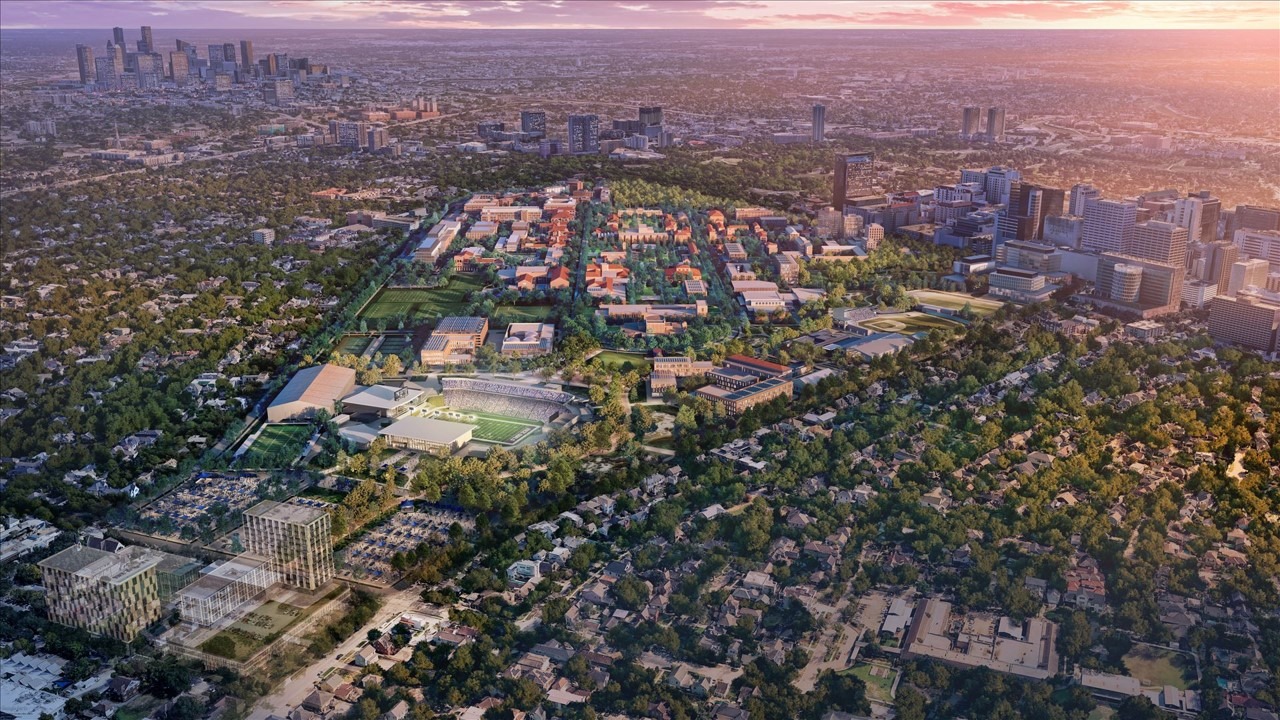
Founded in 1912, Rice University is a renowned research institution uniquely defined by its community, culture, architecture, Live Oak trees, and vibrant context in the metropolis of Houston, Texas. Over the next 10 years, Rice anticipates a growth of more than 19,000 students, necessitating an increase in approximately 4 million square feet on campus. To accommodate these needs while supporting their commitment to research, innovation, and sustainability, the university engaged Sasaki to develop a framework plan to guide the next 30 years of campus development.
The plan preserves Rice’s defining characteristics—its arboretum-like setting, residential college culture, and architectural consistency—while preparing for significant growth. Informed by Rice’s 2024 Strategic Plan Momentous, Sasaki’s framework plan aims to create a more cohesive and dynamic university experience by seamlessly integrating academic, residential, and recreational spaces while supporting Rice’s academic mission and environmental goals and honoring the historic campus structure. Central themes include creating a vibrant, inclusive campus life, expanding and connecting research, reinforcing the landscape as both ecological infrastructure and community amenity, and actively pursuing campus-wide decarbonization.
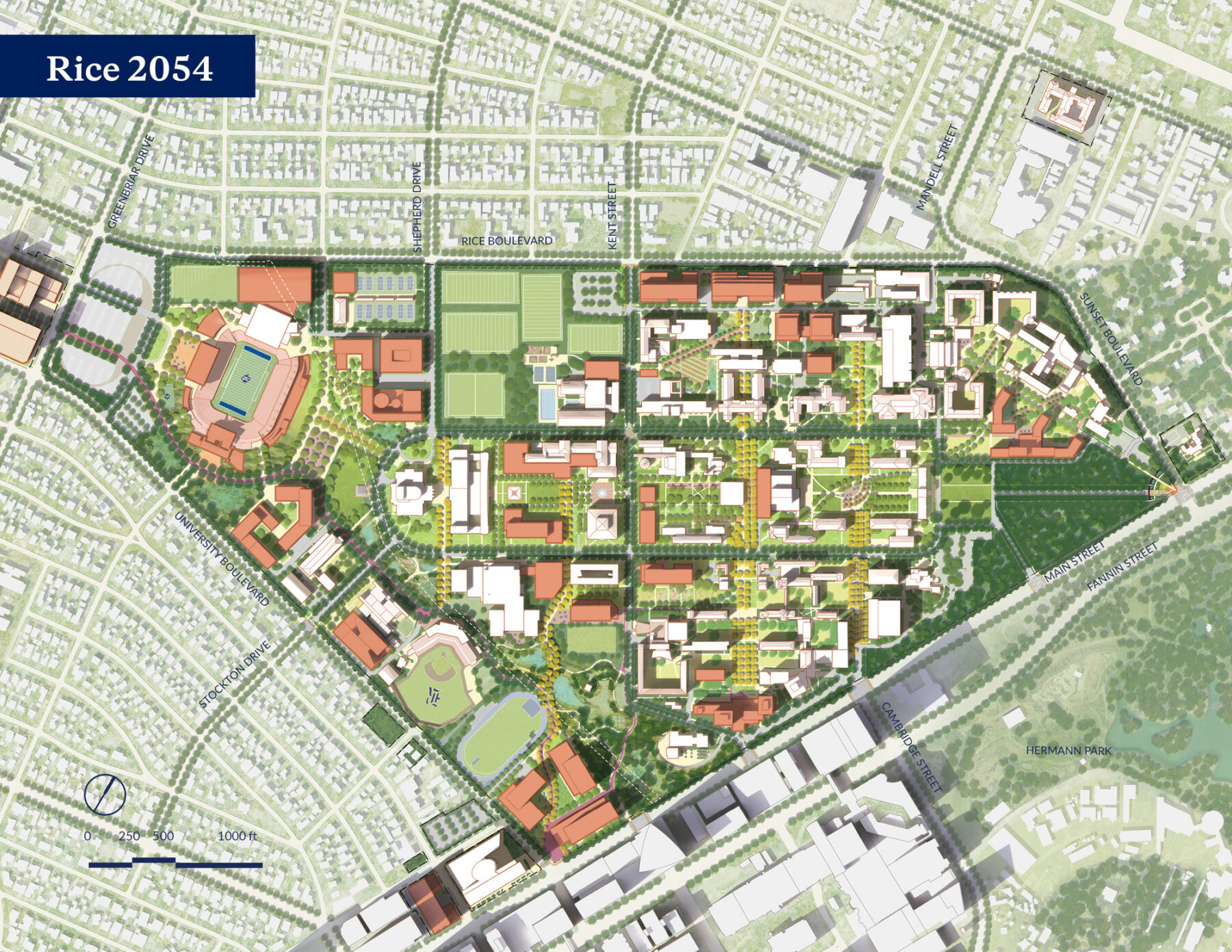
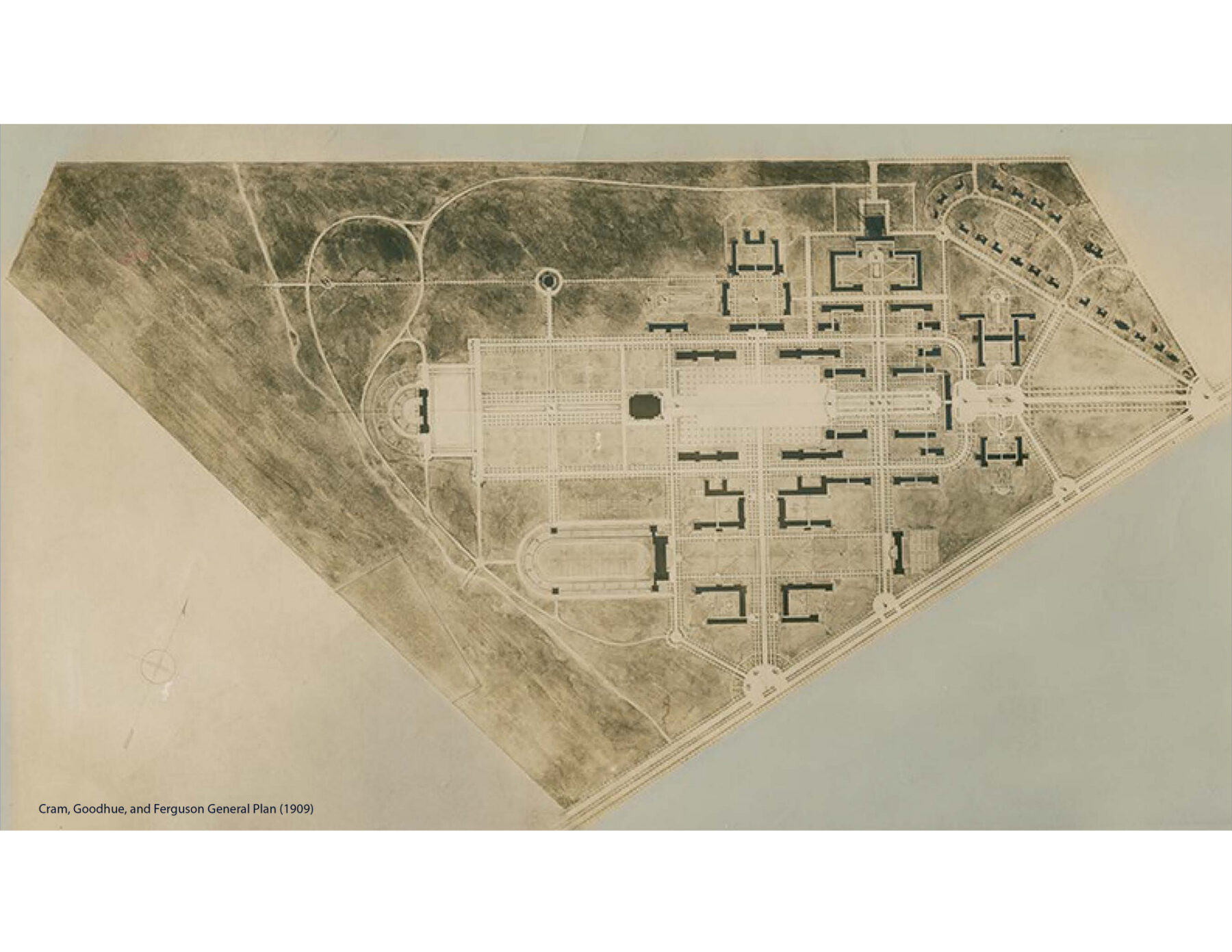
The campus has a rich history of thoughtful planning since its inception– from Cram, Goodhue, and Ferguson’s 1909 General Plan to Kieran Timberlake’s Integrated Campus Plan in 2014.
Integrated campus life
The Framework Plan envisions a distributed network of campus commons that extend the residential college model to the broader university population. The introduction of academic and research clusters will enable significant growth to support thriving communities, generating sustainable futures and leading innovations in health. The creation of academic and residential districts will foster a more integrated campus where students, faculty, and staff can interact and engage more easily. The development of new commons, including the Main Campus Green, will provide spaces for both formal and informal activities, enhancing the campus’s social and academic life.
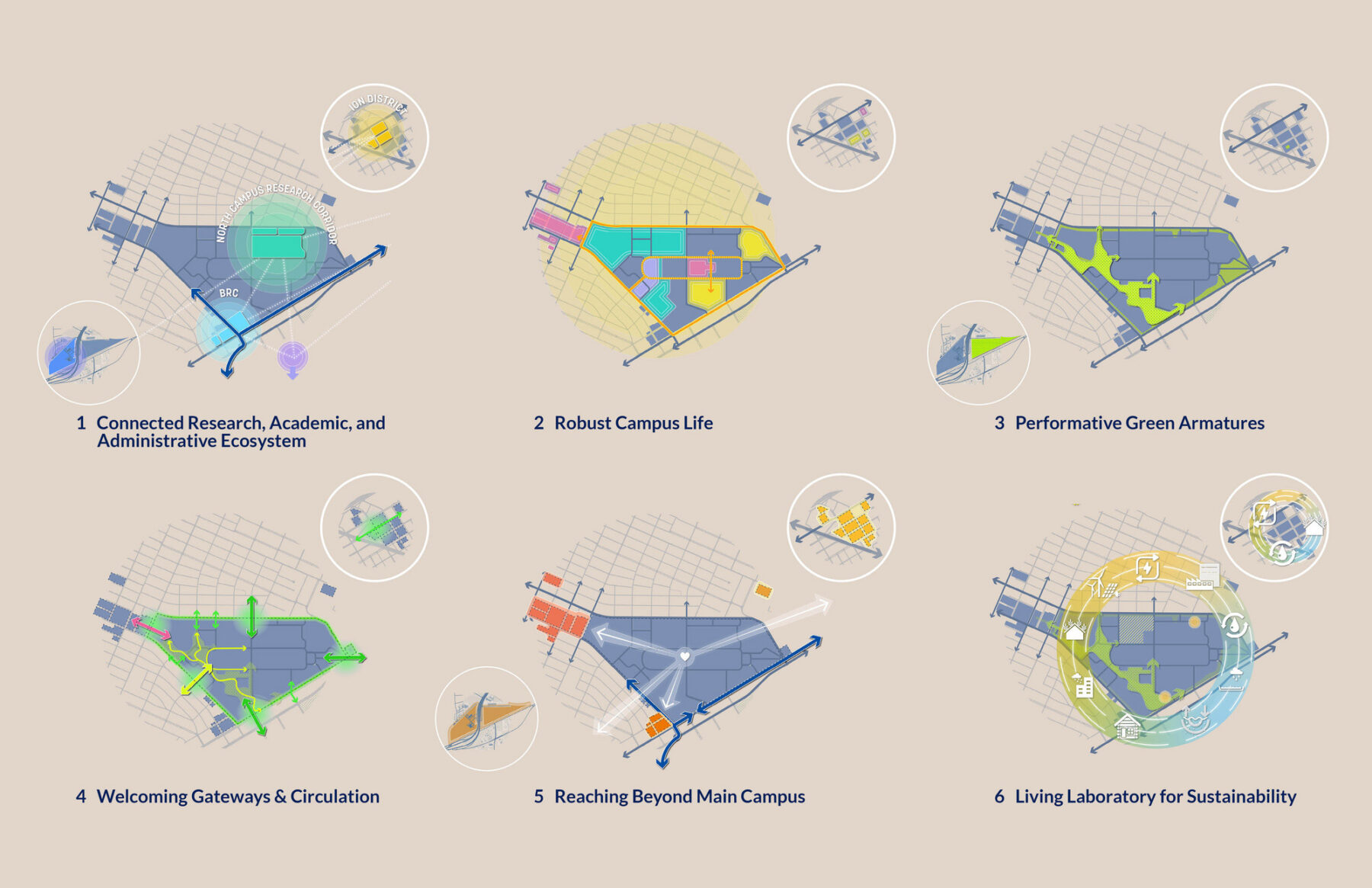
Building on Rice University’s extraordinary assets, the Framework Plan introduces six interrelated design strategies—“Big Ideas”—each offering significant opportunities for campus transformation.
Improvements to pedestrian pathways, bicycle access, and transit connections will create a more connected campus. Increased use of sustainable modes of transportation and reinforcing vehicle-free cores while improving walkability across districts reduce traffic congestion and environmental impact. Dedicated bike and micro-mobility routes connect new colleges, research districts, and transit nodes.
To sustain Rice’s projected growth, the plan proposes the expansion of on-campus housing and student life amenities that provide more opportunities for student engagement while fostering community, collaboration, and academic success. Reimagined edges and entry points—especially along Main Street and Rice Boulevard—will better welcome visitors and symbolically “dissolve the hedges” to strengthen community ties.
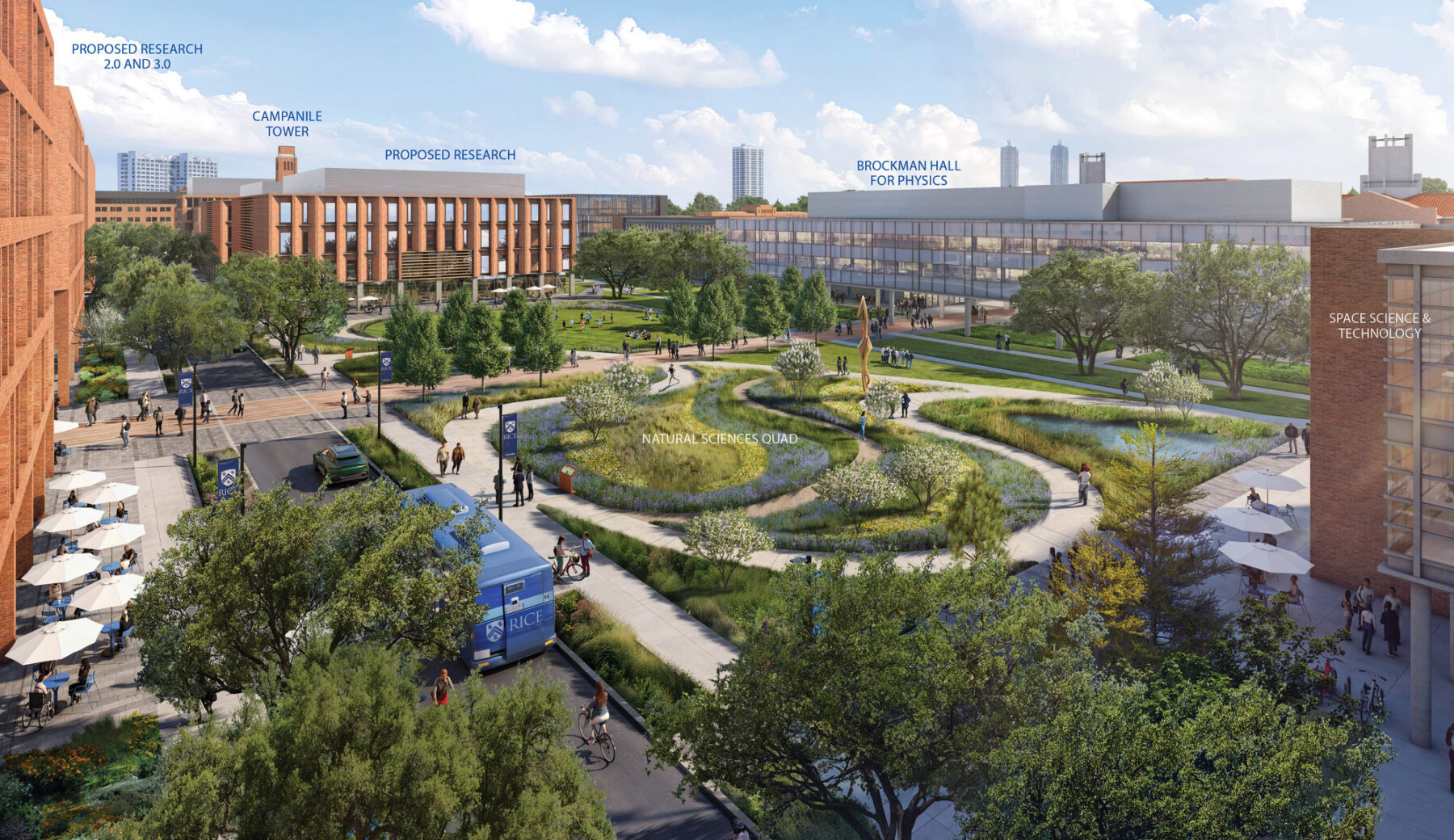
Bounded by 21st-century research facilities on its northern and eastern edges, a proposed research quad replaces aging infrastructure with a versatile outdoor gathering space that extends indoor learning environments outward.
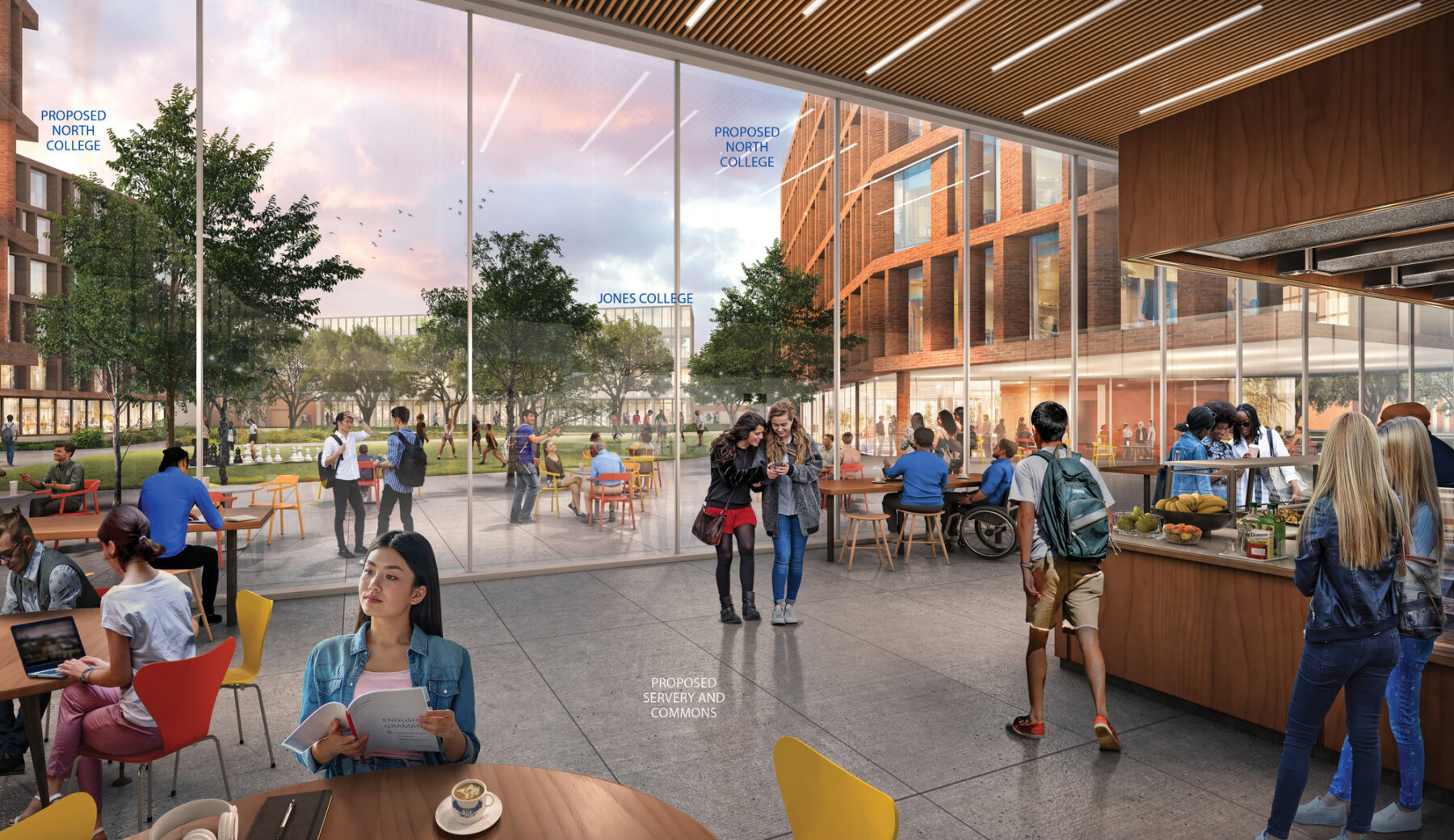
A proposed servery is designed to capture the unique Rice experience through purposeful indoor and outdoor spaces that facilitate community meals, social events, and collaborative interactions.
Landscape as a living laboratory
Rice’s arboretum setting, shaded by live oaks and composed of quads and gardens, is a defining feature of campus. The framework plan seeks to preserve this sense of place while adapting to urban growth and climate stressors. A series of thematic frameworks provide a comprehensive and integrated guide for incremental change, with core objectives including upgrading the arboretum from Level I to Level II, balancing built growth with open space, and improving stormwater management across campus.
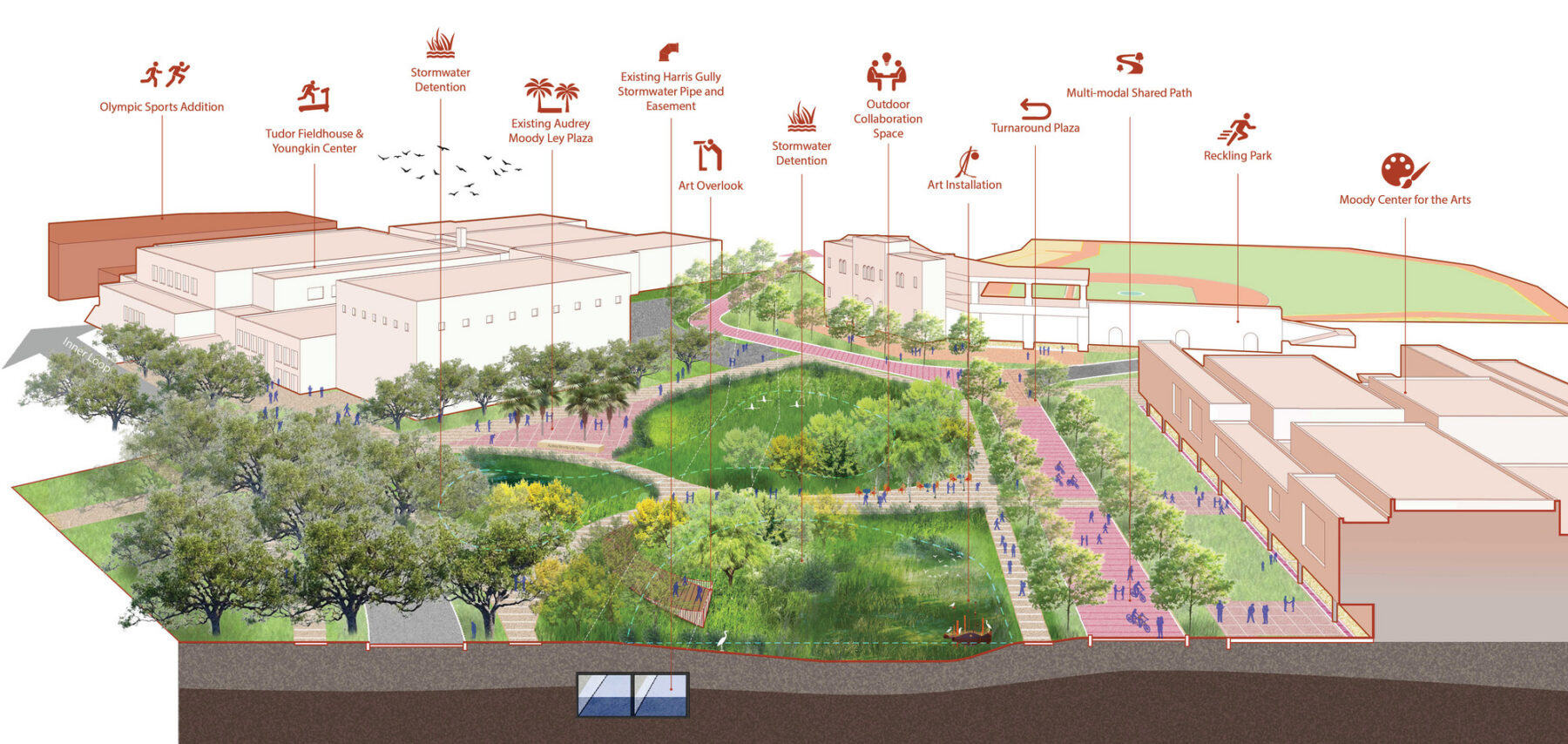
The design enriches and leverages Rice’s landscape and public realm to improve health and wellness, mitigate climate impacts, preserve the campus ecology, and promote biodiversity.
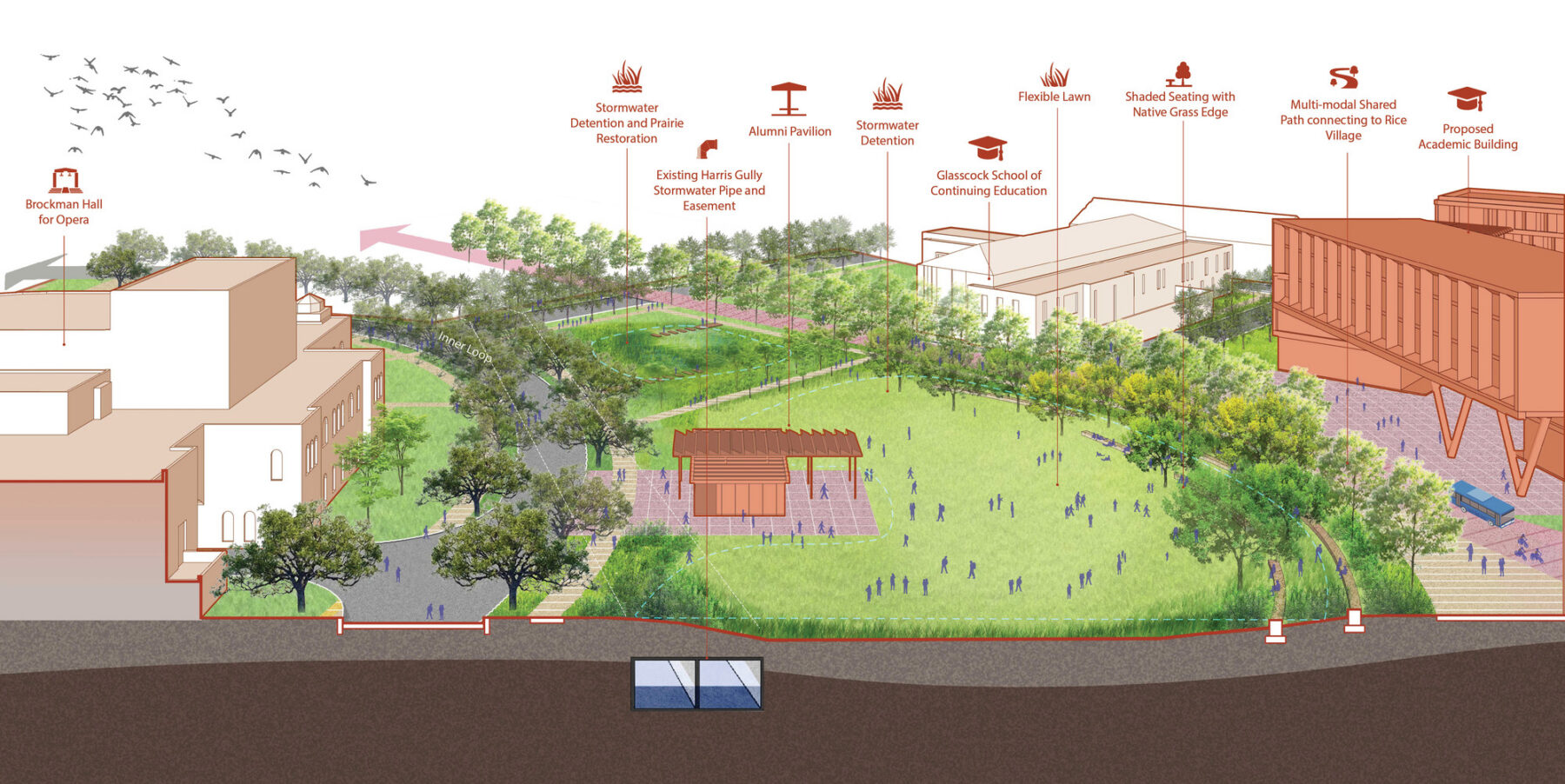
Categorized into different open space typologies– formal quads, residential courts, plazas, connective corridors, and naturalized areas– the landscape framework integrates green infrastructure such as rain gardens, bioswales, permeable paving to future-proof the campus against flooding, heat, and drought. The most transformative landscape initiative is the West Campus Greenway, which overlays the Harris Gully stormwater channel. Currently dominated by surface parking, this area will become a linear ecological corridor that provides major stormwater detention, expands tree canopy, offers recreational and educational spaces, and serves as a biodiversity corridor, reinforcing Rice as a living laboratory for sustainability.
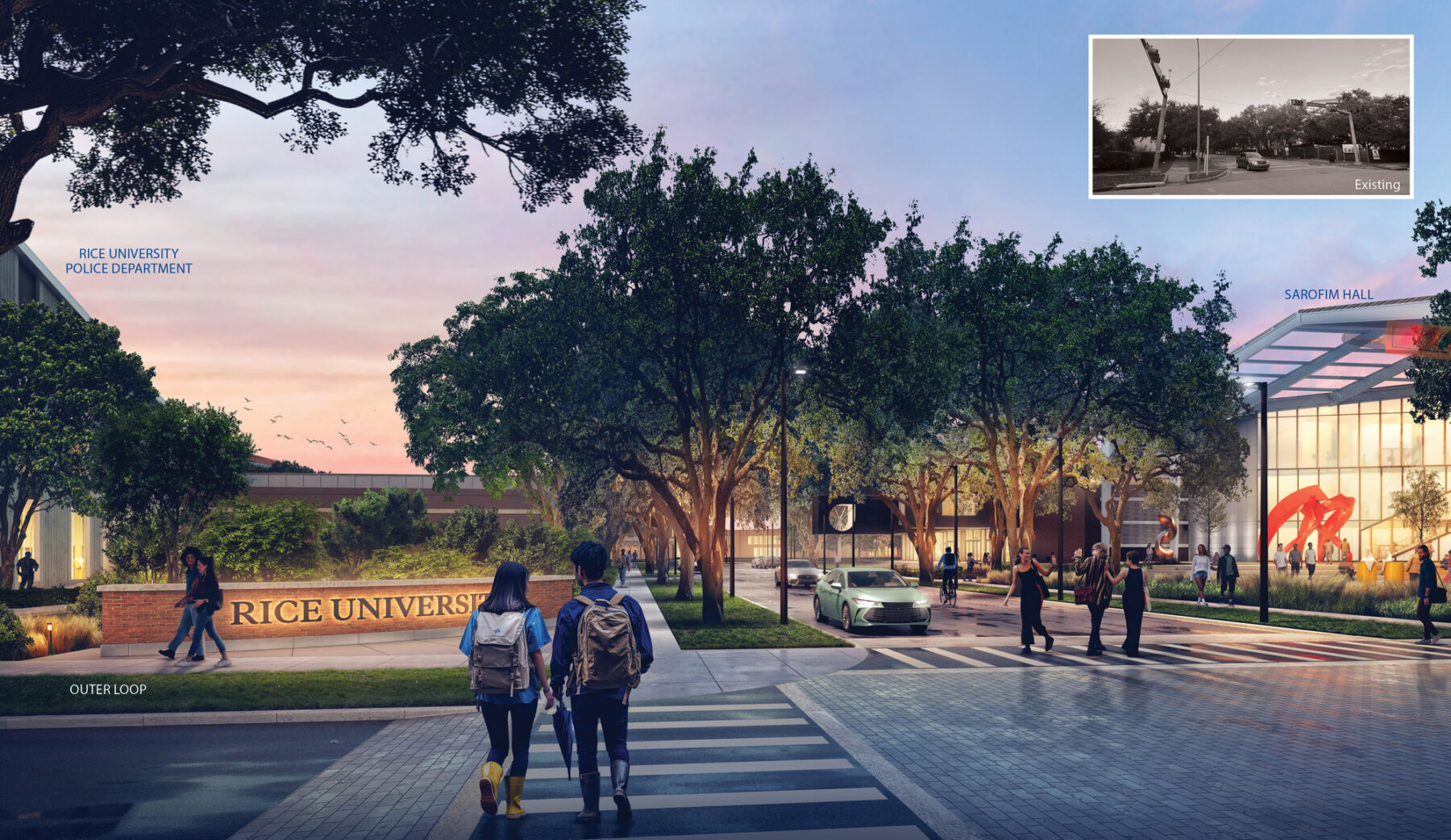
Key gateway transformations will integrate signage, landscape, and public realm improvements into welcoming thresholds.
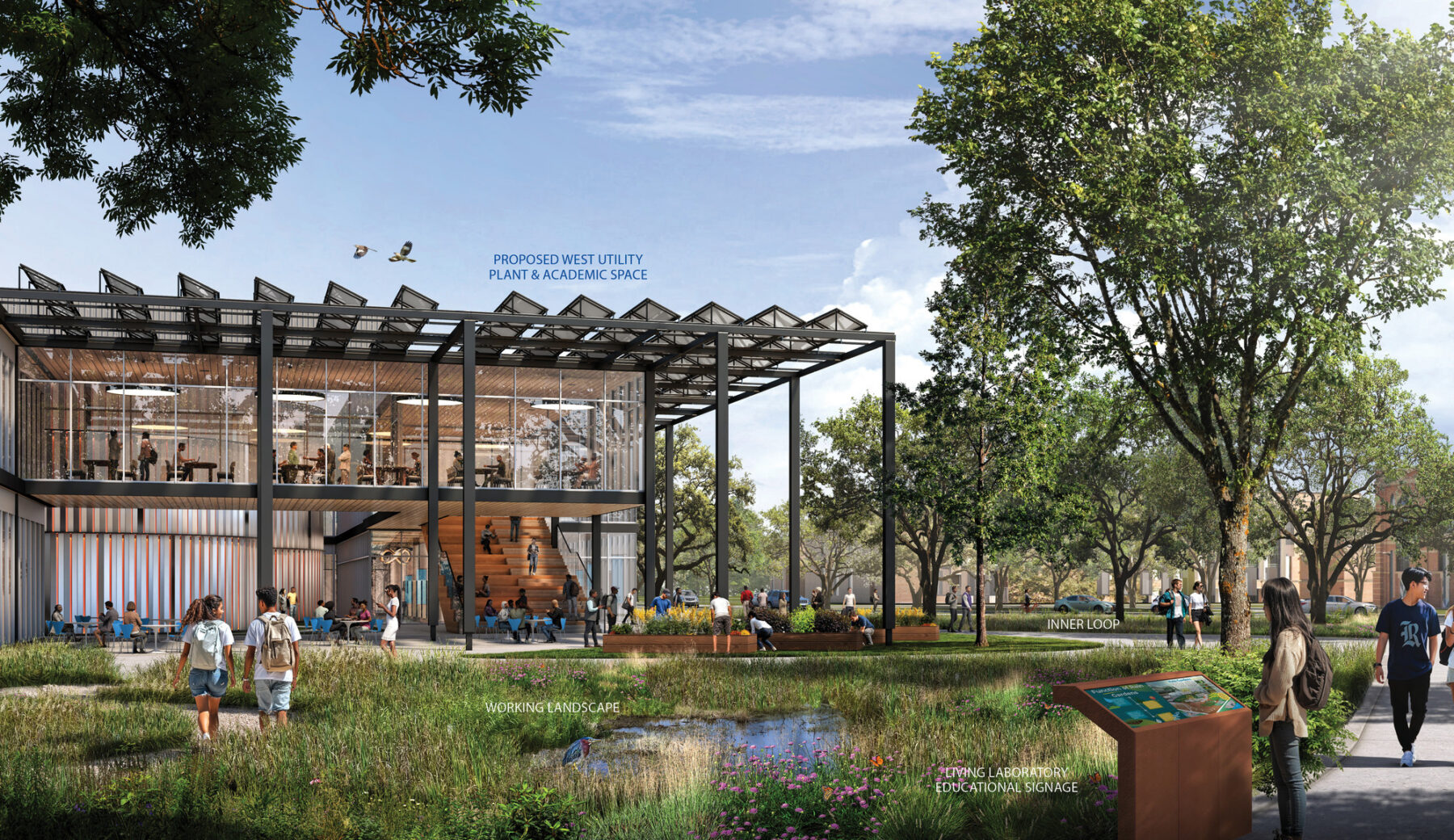
The proposed West Utility Plant embodies Rice’s commitment to sustainability as a living laboratory, offering interactive experiences with cutting-edge environmental technologies.
Scaling Rice’s research enterprise
Driven by the strategic plan, Rice is set to become a premier global research institution, focused on innovations in health, sustainable futures, and thriving urban communities. Two new primary research clusters will help define this growth: the North Research District, anchored by a new Natural Sciences Quad and future Research 2.0 and 3.0 buildings, and the South Research District, an area adjacent to the Texas Medical Center designed to strengthen collaborations in biomedical sciences, engineering, and translational research. These research spaces will be directly linked to residential, social, and teaching spaces across campus, supporting Rice’s overarching goal of a connected campus ecosystem.
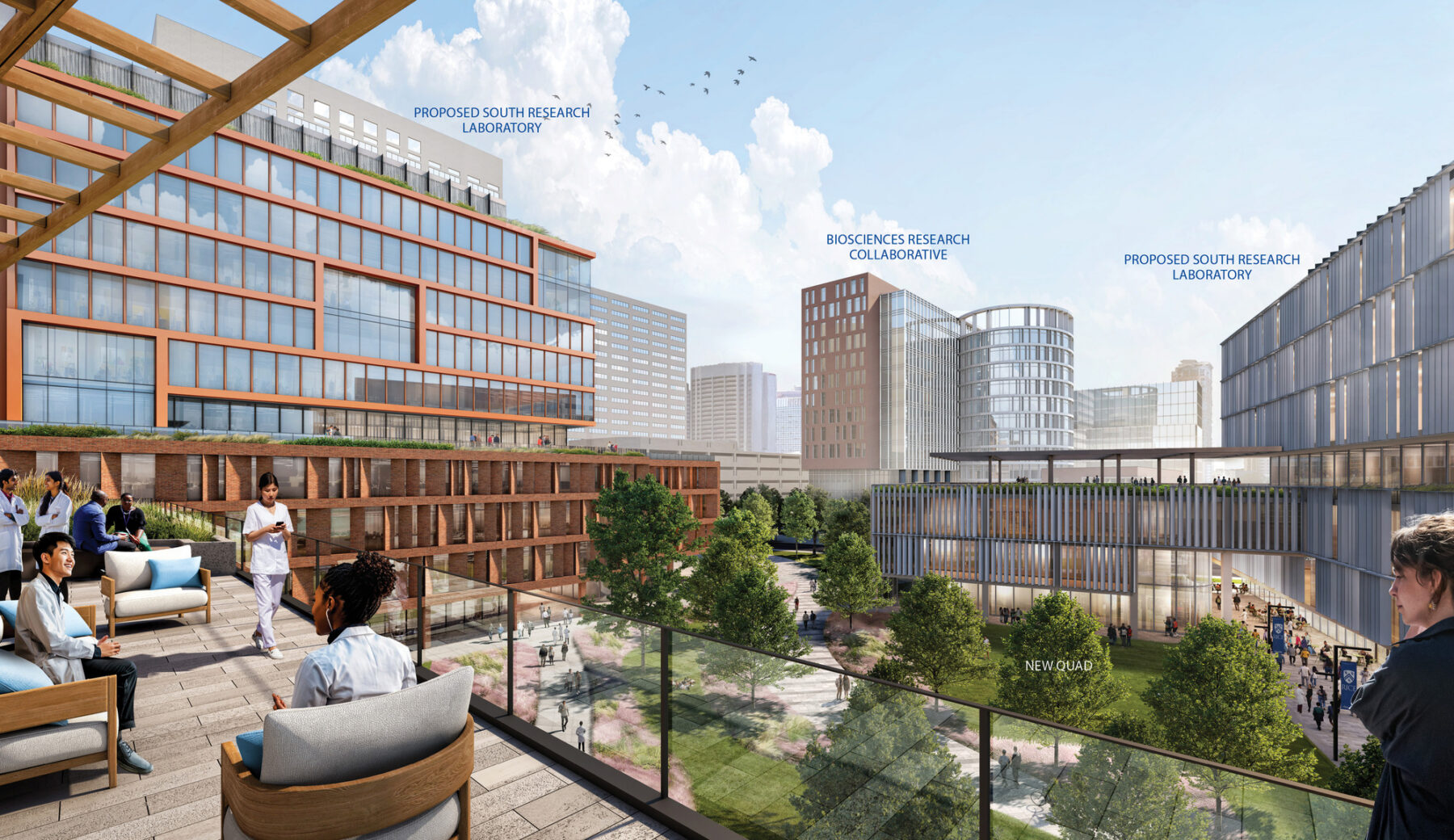
The proposed South research Cluster advances Rice’s academic and research objectives while creating a resilient, integrated network of spaces throughout Houston’s innovation ecosystem.
Achieving carbon neutrality
With almost 4 million new square feet of space expected by 2054, Rice University plans to advance toward its goal of achieving carbon neutral status. To meet this goal, phase two of the framework plan outlines a multi-phase decarbonization strategy that emphasizes energy efficiency, the electrification of heating and cooling, central plant modernization, replacing steam with low temperature hot water distribution with geothermal bore fields, and operational measures. Specific efforts include the encouragement of new building performance standards in new construction, retrofitting existing buildings to reduce energy loads, the construction of a West Utility Plant to anchor resilient infrastructure, introducing both on- and off-campus sources of renewable energy, and the active incentivizing of sustainable commuting.
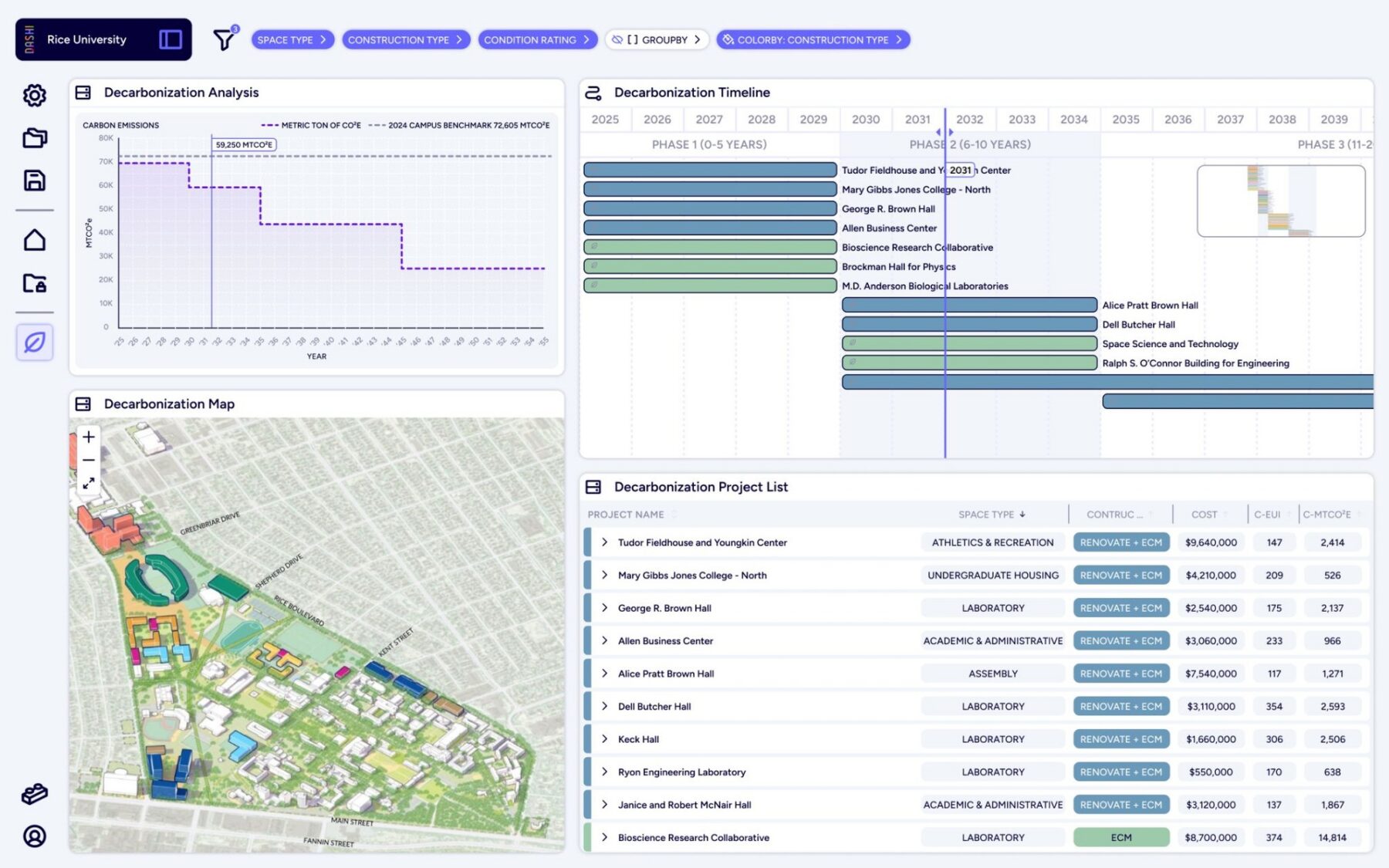
Central to developing Rice’s decarbonization roadmap was the use of Sasaki’s Dashi platform, which provided a data-rich, scenario-based modeling environment that integrated land use, building performance, and infrastructure strategies. Using Dashi, the planning team simulated campus growth against different energy system pathways, testing trade-offs between efficiency upgrades, central plant modernization, electrification, and renewable procurement. This allowed Rice to visualize how design decisions in building massing, orientation, and systems directly impacted long-term energy demand and carbon outcomes. By linking physical planning with operational performance, Dashi enabled the university to adopt a phased, evidence-based approach to carbon neutrality that aligns growth with resilience and cost-effectiveness.
A data-informed engagement approach
Throughout the planning process, the team collaborated closely with key university stakeholders, conducting surveys, focus groups, and community forums to gather feedback and understand the priorities of faculty, students, and staff. This data-informed approach—supported by campus utilization analysis and feedback from engagement sessions—guided decisions around key areas, such as housing, mobility, and academic spaces, as well as sustainable growth strategies.
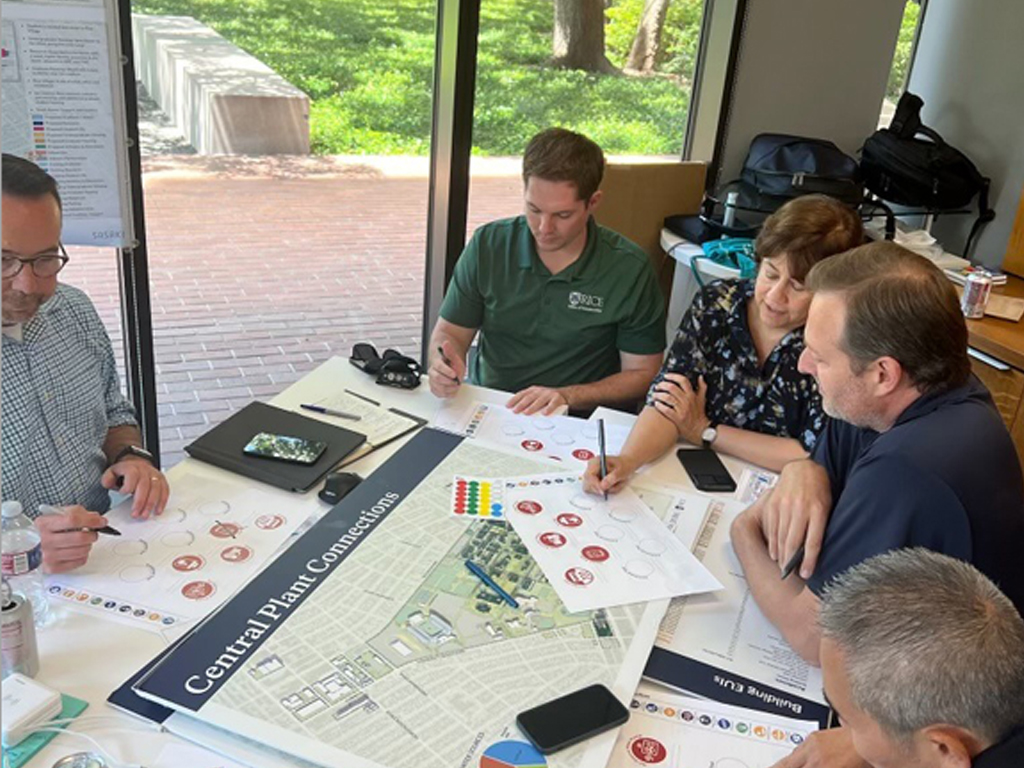
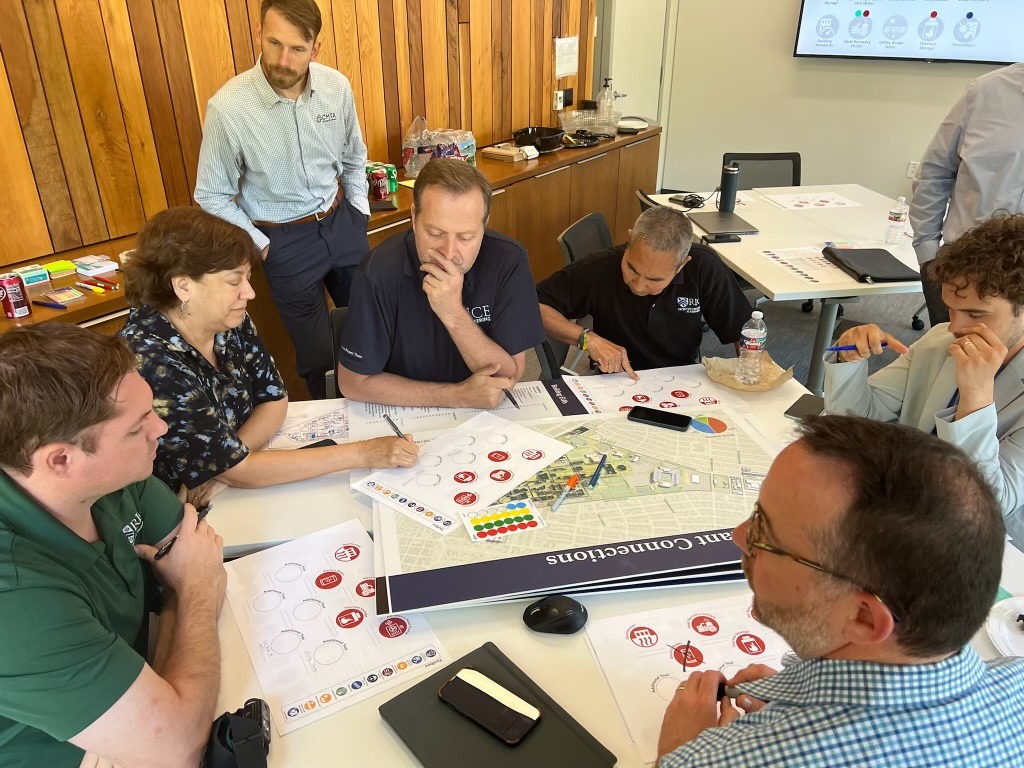
Completed in 2025, the Rice University Framework Plan articulates a vision where community, landscape, research, and sustainability form an integrated whole, positioning Rice to meet its aspirations as a premier teaching and research institution while embodying resilience, and inclusivity in its physical campus.
想了解更多项目细节,请联系 Mary Anne Ocampo.